
Hail and Wind Damage Claims on Large Commercial Buildings: What Owners Should Know After the Texas, Oklahoma and Kansas Storms
Hail and wind can damage a large roof in minutes, but the insurance claim that follows can take months or years. Here is what owners of hotels, office buildings, shopping centers, supermarkets, churches and industrial properties should know before the adjuster arrives.
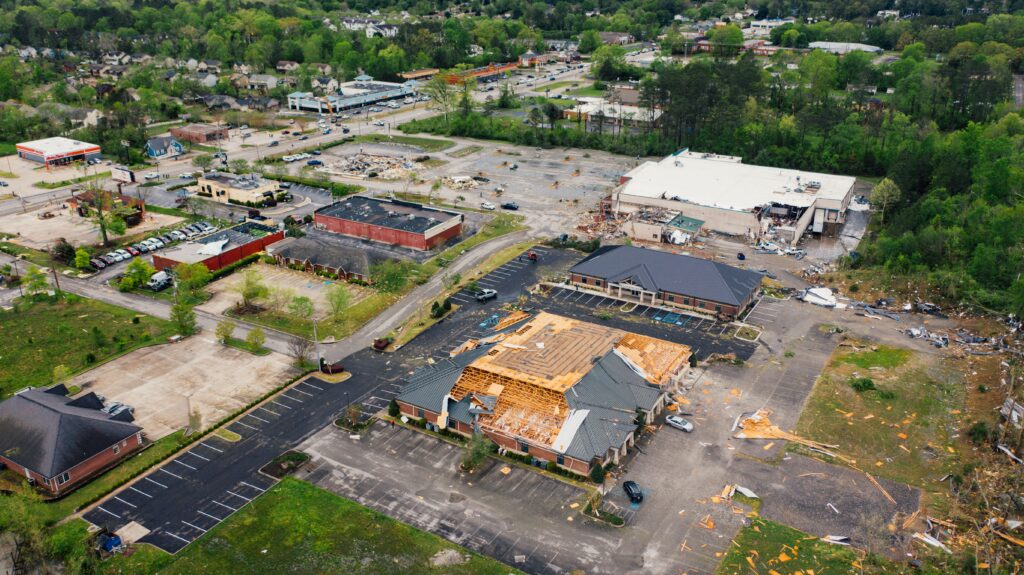
Forecasters warned of severe thunderstorms with large hail and damaging winds across parts of Texas, Oklahoma and Kansas on Saturday, November 21, 2026. It caps another expensive year: Aon estimated that U.S. severe convective storms caused more than $43 billion in insured losses through the first nine months of 2026, the fourth straight year above $40 billion by Gallagher Re’s count.
For the owner of a single large building, such as a hotel, an office tower, a shopping center, a supermarket, a church, a warehouse or a manufacturing plant, one hailstorm can mean a seven-figure roof claim. Those are exactly the claims insurers scrutinize most closely.
Why Large Commercial Hail and Wind Claims Get Disputed
The same arguments come up again and again on large roofs in Texas, Oklahoma, Kansas and across the country:
- “Wear and tear” or “pre-existing damage.” The carrier attributes hail or wind damage to age, deterioration or an earlier storm.
- “Cosmetic” damage. Some commercial policies exclude cosmetic hail damage to metal roofs and panels, and carriers sometimes stretch those exclusions to damage that affects how the roof performs.
- Repair versus replacement. The adjuster scopes spot repairs on a roof that cannot be repaired without replacing whole sections.
- Matching and code upgrades. Whether the policy pays for matching materials and for work required by current building codes, often under ordinance-or-law coverage.
- Actual cash value roof schedules. Some policies pay roofs on a depreciated schedule rather than replacement cost.
- “Below the deductible.” On policies with percentage wind and hail deductibles, a low estimate can wipe out the claim entirely.
A Recent Example: Oklahoma's Findings on State Farm Roof Claims
In November 2026, Oklahoma’s Insurance Department adopted an examination of State Farm’s wind and hail claims. Where independent engineers inspected roofs and found storm damage, their repair estimates exceeded the deductible in 22 of 27 cases, contrary to State Farm’s own determinations. State Farm, which disagrees with the findings, agreed to a settlement of more than $45 million. Read our analysis of the State Farm roof claim findings.
The lesson for commercial owners: the insurer’s first estimate is a starting point, not a final answer.
What Commercial Owners Should Do After a Hail or Wind Storm
- Report the loss promptly and confirm the report in writing.
- Document the roof and building with dated photos, drone images if possible, and the date and time of the storm.
- Prevent further damage with temporary repairs, and keep every invoice.
- Hire your own experts. A roofing consultant, engineer or public adjuster can scope the damage independently.
- Track business interruption from day one, including lost revenue, extra expenses and closed rooms or departments.
- Read the policy for the wind and hail deductible, cosmetic damage exclusions, roof payment schedules, appraisal and suit limitation provisions.
- Be careful what you sign. Proofs of loss, releases and “final” payments can affect your rights.
When an Appraisal or Lawsuit Makes Sense
When the dispute is about the amount of the loss, many commercial policies allow either side to demand appraisal. When the insurer denies coverage outright, accuses the owner of misrepresentation or will not move, litigation may be the only path to full payment. Either way, the case usually turns on expert evidence about what the storm did to the roof, so it pays to build that record early. Large losses also often include business interruption claims that need their own proof.
Common Questions About Commercial Hail Claims
Does hail have to break through a commercial roof for the claim to be covered?
Not necessarily. Many policies cover direct physical damage to the roof system even when it is not leaking. Some policies, however, contain cosmetic damage exclusions for metal roofing and similar materials, so the exact policy language matters.
What is a percentage wind and hail deductible?
Many commercial policies in hail-prone states use a deductible equal to a percentage, often 1% to 5%, of the building’s insured value rather than a flat dollar amount. On a large building, that deductible can be substantial, which makes an accurate damage estimate even more important.
Should I let the insurance company's engineer inspect the roof alone?
You should cooperate with the inspection, but it is wise to have your own roofing consultant, engineer or public adjuster present and to document the roof independently.
How long do I have to file suit if a commercial hail claim is denied?
It depends on the policy and the state. Many property policies contain contractual suit limitation provisions that can be much shorter than the general statute of limitations, so check the policy as soon as a dispute arises.
About Liss + Earls
For nearly 40 years, Liss + Earls has represented only policyholders, never insurance companies, in property insurance disputes, including large commercial hail, wind, fire and water losses. The firm is licensed in Michigan and Ohio.
Managing Shareholder Jason J. Liss has represented property owners in very large fire, storm and water damage losses across the country. Liss + Earls is licensed in Michigan and Ohio. In other states, including Texas, Oklahoma and Kansas, we consider only large commercial losses, typically involving $1 million or more in damage, on a select basis, through pro hac vice admission with local counsel. Liss + Earls is not licensed in Texas, Oklahoma and Kansas, and pro hac vice admission is subject to court approval. Learn more about our nationwide representation for high-value claims.
Sources: National Weather Service forecasts as reported by KOCO and others (Nov. 2026); Aon and Gallagher Re as reported by InsuranceNewsNet (Nov. 3, 2026); Oklahoma Insurance Department examination as reported by Repairer Driven News and Insurance Journal (Nov. 18, 2026). This article is general information, not legal advice. Every policy and claim is different.