
What Property Owners Need to Know Right Now
Michigan Severe Storm & Flooding Damage
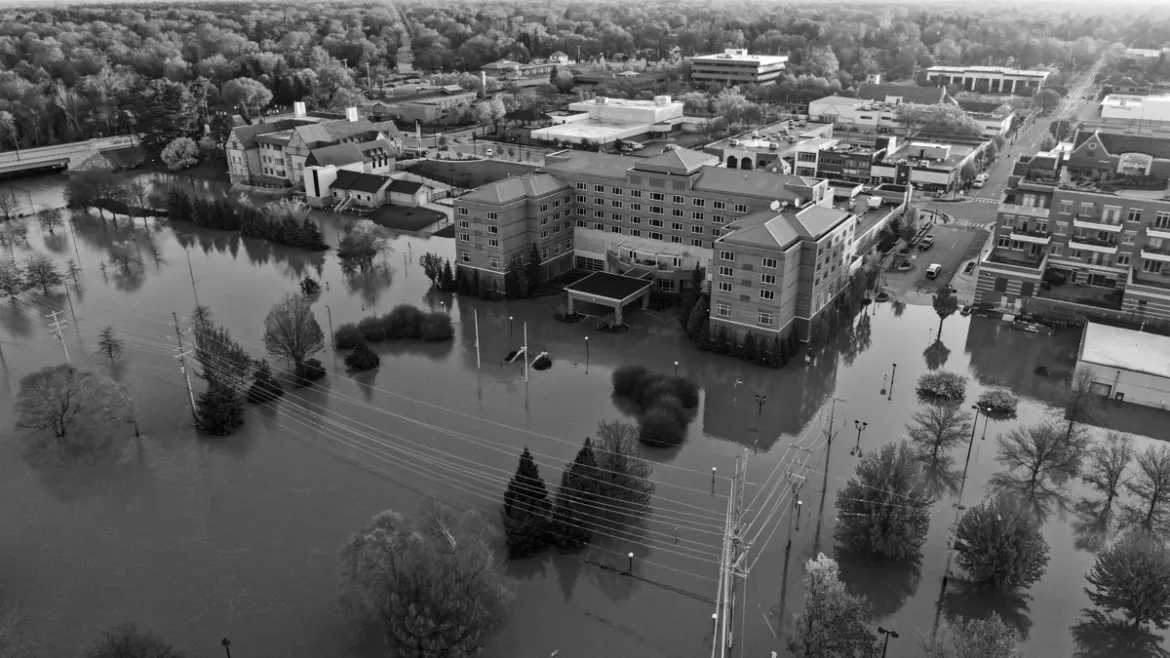
April 2026: Michigan is in the middle of the most significant flooding event in over a decade. For the first time in recorded history, the entire State of Michigan is under a flood watch. Governor Whitmer has declared an energy emergency. Severe storms overnight brought tornado warnings to central and southeast Michigan, building collapses and power outages to Ann Arbor and Washtenaw County, and a declared local state of emergency to Traverse City and Grand Traverse County. Flood warnings are active across Cheboygan, Emmet, Grand Traverse, Wexford, Newaygo, Osceola, Arenac, and Oscoda counties. Southeast Michigan has received up to 4.5 inches of rain in the past 10 days, with more forecast through the end of the week.
Areas Hit Hardest by April 2026 Michigan Severe Storms & Flooding
Ann Arbor & Washtenaw County
Michigan severe storms caused building damage across Ann Arbor, including the collapse of the east wall of Veterans Memorial Park Ice Arena. DTE Energy reported more than 15,800 customers without power as of Wednesday morning, with outages concentrated in Ann Arbor, Ypsilanti, and Romulus. Flooded roads have been reported throughout the city and surrounding areas. Homeowners and businesses with water intrusion, wind damage, or power-surge damage should document everything immediately and contact their insurance carrier — but understand the claim process before you agree to anything.
Traverse City & Grand Traverse County
Traverse City officials declared a local state of emergency after the Boardman River swelled from days of heavy rainfall, causing a sinkhole roughly the size of a car to open near the river. A bridge washed out near Traverse City, the airport was closed, and roads remain impassable in parts of Grand Traverse County. For commercial property owners, marina operators, and hospitality businesses along the lakeshore and river corridors, the damage to structures, inventory, and business income can be substantial.
Northern Michigan — Cheboygan, Emmet, Wexford, Newaygo & More
State and local officials continue to monitor conditions at the Cheboygan Lock and Dam Complex, where rising water from snowmelt and heavy rain has pushed the Cheboygan River to dangerously high levels. Emergency managers in Antrim County have warned that if the culvert at Bridge Street in Ellsworth fails, a large volume of water could be released immediately, causing widespread flooding along the Upper Chain of Lakes. Flood warnings are active across Cheboygan, Emmet, Newaygo, Osceola, Wexford, Arenac, and Oscoda counties.
What Property Owners Should Do Right Now
- Stay safe first. Do not enter a flooded basement or a building with structural damage until it has been cleared. Do not touch electrical panels or appliances in standing water.
- Document everything immediately. Photograph and video every room, every wall, every piece of damaged property, and every inch of standing water BEFORE you start cleanup. This is your evidence. Once you clean up, it is gone.
- Do not throw anything away yet. Damaged contents, drywall, carpet, appliances, and inventory are evidence that the insurance company and its experts may want to inspect. Do not let a restoration company haul it away before the carrier has had the opportunity to see it — and before you have documented it.
- Notify your insurance company promptly. Your policy requires timely notice of loss. Call, get a claim number, and confirm the notice in writing. But do not give a detailed recorded statement until you understand the policy and your rights.
- Pull your full policy — not just the declarations page. The endorsements, exclusions, and conditions are where the real coverage questions live. Flood exclusions, surface water exclusions, groundwater exclusions, sewer backup endorsements, and “sudden and accidental” language all vary by policy and by carrier.
- Be careful about emergency restoration contracts. Many restoration companies will show up within hours, sometimes before the insurance company’s adjuster. Before you sign an assignment of benefits (AOB) or a contract with a restoration company, understand what you are agreeing to. Some of these contracts give the restoration company the right to deal directly with your insurance company on your behalf — and that is not always in your interest.
- Call a property insurance attorney before you sign anything. On a large flood or storm loss, the decisions you make in the first 48 hours — what you sign, what you say, what you throw away, who you let onto the property — can determine the outcome of the entire claim.
The Insurance Issues Michigan Property Owners Will Face
After every major weather event in Michigan, we see the same disputes between policyholders and their insurance companies. Understanding them before they happen is the best protection.
Flood vs. Water Damage: The Exclusion That Catches
Most standard homeowner and commercial property policies exclude flood — meaning rising water from an external source, surface water, and groundwater. If your damage was caused by a river overflowing, surface water accumulating around the foundation, or groundwater pushing through the basement floor, your standard policy may not cover it unless you have a separate flood policy (typically through NFIP or a private flood carrier). However, if your damage was caused by a burst pipe, a roof leak from wind damage, sewer backup, or water intrusion through a storm-damaged opening in the building, that is a different coverage analysis entirely. The distinction between “flood” and “water damage” is where most disputes begin, and getting it right matters enormously.
Wind vs. Flood: The Concurrent-Cause Fight
When a storm brings both wind and flooding — as this week’s storms have — carriers regularly argue that the damage was caused by the excluded peril (flood) rather than the covered peril (wind). Michigan law on concurrent causation is nuanced, and the outcome depends on the specific policy language, the specific facts, and the specific sequence of events.
Sewer Backup Coverage
Many Michigan homeowners have sewer backup endorsements on their policies, but the limits are often far lower than the actual damage. A standard sewer backup endorsement might provide $5,000 to $25,000 in coverage — nowhere near enough for a finished basement with water up to the ceiling. Whether your loss is covered under the sewer backup endorsement, the main water-damage provision, or both depends on the cause of the backup and the language of the policy.
"Sudden and Accidental" Language
Many policies limit water damage coverage to losses that are “sudden and accidental.” When flooding develops over hours or days — as it has this week — carriers will argue the damage was gradual rather than sudden. What “sudden” means in your specific policy, under Michigan law, is a legal question that has been litigated extensively.
Business Interruption for Commercial Properties
If your business has been forced to close due to flooding, wind damage, power outages, or road closures, you may have business interruption coverage — but only if the interruption was caused by direct physical loss to your property from a covered peril. Road closures and utility outages caused by area-wide flooding, without direct damage to your building, create complicated coverage questions. Civil authority coverage, ingress/egress provisions, and service interruption endorsements may apply depending on your policy.
Michigan Law Protections MCL 500.2006 — 12% Penalty Interest
Under Michigan’s Uniform Trade Practices Act, insurers that fail to pay claims on a timely basis can be liable for 12% annual penalty interest. After a statewide weather event like this, carriers are flooded with claims and processing times slow down. That does not excuse late payment, and the penalty interest statute exists specifically for situations where carriers use volume as a reason to delay.
Timely Claim Filing after a Michigan Severe Storm
Many policies require that claims be filed within a specific window — sometimes as short as 60 days for certain coverages. Some policies also require that lawsuits be filed within 12 months of the loss. These deadlines are real, and missing them can forfeit an otherwise valid claim. Do not assume you have unlimited time.
Public Adjusters
After every major weather event, many public adjusters are inundated with new losses. If you are a PA working flood or storm files this week and you have a claim that involves coverage questions — flood vs. water damage, concurrent causation, sewer backup limits, business interruption, or denied or delayed claims—our team is available to take your call. We handle the legal fight in parallel with the adjustment to help best serve your clients.
Large Storm Damage Claims in Ohio or Nationwide?
Jason J. Liss is the Managing Shareholder of Liss + Earls, P.C. (formerly Fabian, Sklar, King & Liss). He has 30+ years of experience representing Michigan and Ohio property owners in first-party insurance claims after flood, storm, fire, water, and explosion losses and represents clients nationwide in select large value commercial property damage claims. Jason is past chairperson of the Insurance & Indemnity Law Section of the State Bar of Michigan, a hearing panelist for the Michigan Attorney Discipline Board, and an active member of NAPIA and NAFI. He holds an AV Preeminent Rating (5.0/5.0) from Martindale-Hubbell and has been recognized in Michigan Super Lawyers, Best Lawyers in America, and DBusiness Top Lawyers. Since 1986, the firm’s attorneys have recovered an estimated $500 million for policyholders.
Michigan Severe Storm Property Damage Claims
When to Call
If your home or business in Michigan, Ohio and beyond has been damaged by this week’s flooding, storms, tornado activity, or related water intrusion — or if you expect to file a claim and want to understand the process before you do — the initial consultation is free and there is no obligation.
For more general questions about the insurance claims process, see our FAQ page.
This article is for general information only and does not create an attorney-client relationship or constitute legal advice about any specific claim. Every policy and every loss is different. If you have a property insurance claim arising from the April 2026 Michigan flooding and storms, please call so we can review the specific facts and the specific policy language.